We’ve come to the end of the Archives Revealed project and we can now announce that the St John Archive’s catalogue is now live and publicly accessible for the first time!
Over the last two years, we have been joined by two incredible Project Cataloguers, Annie Lord and Josie Sommer, and two fantastic Project Volunteers, Pat Halpin and Joyce Guillaume (who have contributed 795 hours to the project alongside their existing volunteering roles within St John Ambulance).
We’ve been sorting, cataloguing, and re-packaging the founding records of St John Ambulance for the period 1870s – 1939, and it has brought to light never-before-seen records of St John Ambulance’s early volunteer-led first aid movement, such as the original blueprints for the first ‘St John Ambulance’ litter, and records for 532 individual Divisions of the St John Ambulance Brigade in England and across the world.
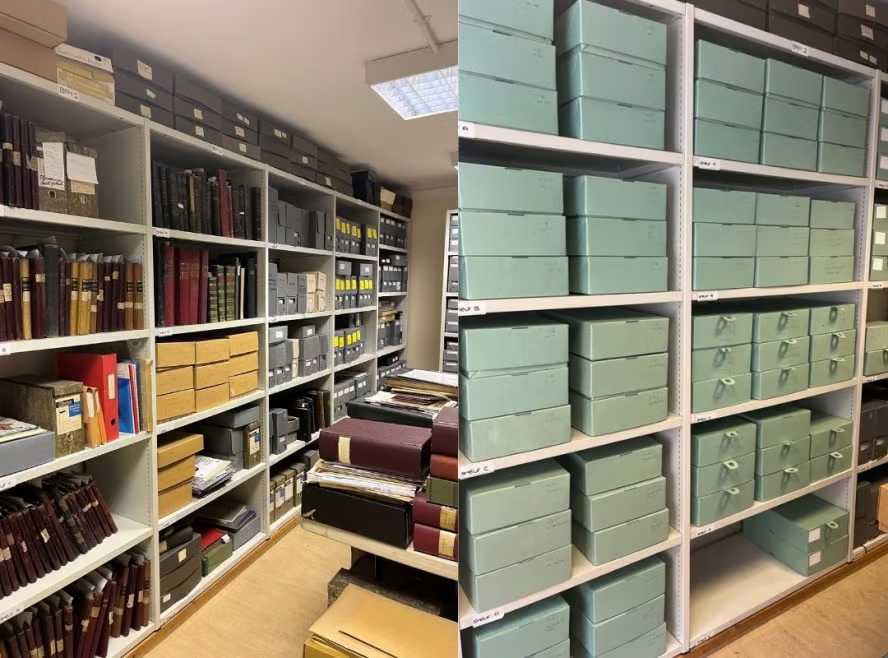
The team has catalogued 2,715 records and filled 373 boxes, and I am so proud of all four of them and the hard work they have done to enable us to care for and provide access to the Archive. This project has been (and I know I’ve said it many times before), truly transformational.
Let’s hear from the team, and introduce the catalogue!
What is your favourite item that you’ve come across in the Archive?
Joyce (Project Volunteer)
Sir Vincent Hunter Barrington Kennett-Barrington’s diaries! Kennett-Barrington was a humanitarian who worked with the National Society for the Relief of the Sick and Wounded in War [British Red Cross] and St John in the mid-late 1800s. His diaries contain personal reflections on the wars in Europe in the 1860s and 1870s, including emotive sketches which reflect on his experiences, and later, his diaries of his travels to Ceylon [Sri Lanka] and India. His records contain a newspaper report from 1890 relating to a St John Ambulance Association meeting in Ipswich where he was presenting First Aid Medallions and certificates to successful students. During his speech at this meeting, he vigorously denounced war and described it as: ‘a slur upon civilization and a disgrace to Christianity.’ Joyce wrote a wonderful blog post about Vincent which you can read here.

Sophie (Archivist)
I think it has to be some of the person-centric records, such the diary-cum-scrapbook that Joan Curtis (a St John Ambulance Brigade Nursing member in the 1910s), wrote about her experiences of public duties and a published history of the Calcutta Nursing Division [India] which includes information and photographs. These records go beyond the organisational narrative and tell us about the real experiences of the St John volunteers on the ground.

Josie (Project Cataloguer)
It has to be Josef Neuss’ 1878 drawings of ambulance litters. When I saw these pencil drawings, they really brought to life the human endeavor behind first aid. I think first aid and healthcare can be something we assume has always been a state-led activity in the UK, but of course the history of organised first aid is much shorter and more grass-roots than we might think. These drawings, with ever so slight adjustments intended to bring more comfort to injured people, show how it was a collaborative, European-wide and evolving landscape. And they’re beautiful, fragile artworks in their own right.

Pat (Project Volunteer)
I have a number of items that have taken my interest – the Lord William Thyssen-Amherst papers (the Annual publications of the Commissioner-in-Chief through the 1920s and 1930s), but I think my favourite part has been the Annual Returns, it has been a privilege to handle documents from the 1800s to the 1970s. For many of the Divisions, there were names that I was able to relate to and many that I had not heard of previously. The Annual Returns give us a real insight into the formation of the Brigade from the 1900s to the 1940s.
What have you learned from the project?
Sophie (Archivist)
I have learned the supreme value of organisational volunteers! In museums, libraries, and archives, we all know the value of our volunteers, but Pat and Joyce, our exceptional Project Volunteers, really have been the most incredible asset to the project. Between them, they have decades of experience in volunteering with St John Ambulance in a first aid setting, and the knowledge of organisational jargon and structure they have brought to the project, together with an unstoppable joy and inquisitive nature has been brilliant. They have really helped us to understand the St John that we have been cataloguing.

Joyce (Project Volunteer)
There is always more to do!

Josie (Project Cataloguer)
I’ve learned about the development and dissemination of first aid across England at the end of the 19th century and beginning of the 20th century, and how this was done with the assistance and frontline actions of ordinary people volunteering in their communities. I’ve also learned about the value of having a project Steering Committee (which I’d never been part of before); having external oversight and pointers has been brilliant for us as staff.
Pat (Project Volunteer)
Although we have been working on this for nearly two years, we have only scratched the surface of what the Archives have. I have learnt new skills from the team as well as being able to impart what little knowledge we hold (in the grand scheme of things). The “Lord William Thyssen-Amherst, 1st Baron Amherst of Hackney papers” hold fascinating insights into the early years before the formation of the Order of St. John and then St John Ambulance Association and Brigade. One of my favourites was “mourning stationery” which signified that someone or organisation was in mourning; this is evident in much early correspondence throughout the files, some of these were from the Royal Households. It usually consists of a black border around headed paper, black marks on correspondence or a black envelope.

What has surprised you about the Archive?
Sophie (Archivist)
How much stuff it contains! You can look at a shelf of 9 boxes, but out of the boxes comes so much paperwork, so much documentation, so many records… the sheer abundance of material is incredible!


Joyce (Project Volunteer)
The variety of the information! I thought the Archive was going to be quite bureaucratic, but I didn’t realise it contained records such as press cuttings and correspondence from important St John people, for example. The extent of the collections is vast! Also, how many copies of First Aid to the Injured were produced! This was the first manual of first aid that the St John Ambulance Association produced (published 1870s – 1950s), and many, many millions of copies were published across the country (and the world, including many editions translated into a variety of languages!)

Pat (Project Volunteer)
The team! Although we have worked on the Archives Revealed project, there is so much work undertaken by the Museum team – collating trophies, silverware, uniforms, and much more. My favourite room is the Mellows Library and the windows and markings above them which show where the Order was established. What has surprised me most is how little I know of the organisation; especially the history despite the many years I have been with the organisation.
Josie (Project Cataloguer)
The thing that has most surprised me is how much the stories and characters of St John people shine through the Archive. Whether it’s an autograph book, good luck telegrams for competitions, press cuttings, heated correspondence about how the organisation should be run, meeting minutes – I don’t think I expected to be able to identify and develop an idea of people in what might appear to be a business archive. This Archive is certainly not just that!
What has been your stand-out moment from the project?
Sophie (Archivist)
It’s a real get-out answer, but there have been far too many to mention! What springs to mind are the many times Joyce would enthusiastically come to tell us about something she’d found in the records, and the in-joke about how the Archive would get a bit louder at ten past ten, when Joyce arrived; the insightful information Pat would bring about the workings of the organisation, the hilarious stories of his life working on the London Underground, and the feeling of everything being ‘just right’ when we’d had a cup of coffee, sat down to begin work, and Classic FM would start to drift throughout the Archive; Josie’s excellent music choices for Mondays when it was just the two of us working in there, and getting to attend her graduate art show and see some of her artwork; Annie’s cool and calm approach to what was an exceptionally daunting start to the project when we started with no idea of what was to come, and the fantastic ‘in scope’ beanies that she made for Pat, Joyce, and I.
My stand-out moments have been all about the people I have had the pleasure of working with, and not the records. The records are obviously important, but the people involved in this project have been what have made it the stand-out success that it has been.

Joyce (Project Volunteer)
There are a few! At the very beginning, when we were completing the inventory/scoping exercise to see what there was in the Archive, it was getting to go into the different parts of the Archive and the Museum building that I didn’t know were there. We did find that some of the records were found in poor conditions, but this project’s work paves the way for ongoing collections care and management to identify and mitigate this kind of situation.
The tea, biscuits and discussion at break times! Lots of opportunity for archive and non-archive chat, and getting to know the rest of the team. The people in the team have been just right.
Finally, I worked with Sophie and Josie to showcase some archival records to St John’s youth members (Cadets and Badgers, aged 5-17) at one of the Museum’s Cadet Open Days, and I taught the young people some historic methods of bandaging – the highlight was bandaging the head of the Lord Mayor of London during a demonstration!

Josie (Project Cataloguer)
For me, the stand-out, not moment, but experience, has been working in the Museum and Archives Revealed teams. It’s been a real treat to work in such a friendly environment with such dedicated and kind colleagues.

Pat (Project Volunteer)
Tuesday mornings are the focal point where we catch up, there have been many cold (very cold) days in the Archive as well as warm days, and it is fair to say that we have worked hard and had fun. One of my favourite memories is of Sophie, Annie and Joyce trying to drill out the lock of an old, sealed metal container at the back of the gardens at St John’s Gate and members of the public looking at us in a curious manner. It was not helped by Sophie wearing a striped jumper and looked like a “classic safe cracker”.

What would you like people to know about the Archive?
Sophie (Archivist)
The Archive is for everyone. You don’t need to be a member of the Order of St John, a volunteer or employee with St John Ambulance, or even a professional researcher to be able to access its records. The Archive is available to everyone.
Joyce (Project Volunteer)
This comes back to the variety of users of the Archive’s collections. They can be used by people who are particularly interested in St John itself, by family historians looking to find out about their ancestors, for researchers exploring the social history of volunteering across the country and across industries. You can find all of that (and more!) in the St John Archive!
Josie (Project Cataloguer)
I’d like people to know that this Archive has infinite entry points and touches on so many areas of history. You might assume that the Archive has records about medical and first aid history, and potentially material associated events where first aid was administered – such as wars or natural disasters, which it does. But, you might not know that the Archive also holds many other stories – about the role of women, the British Empire, regional communities across the UK, industry and the railways, and the contributions of young people. It’s also useful for the history of design and public messaging, as well as thinking about how large community organisations can be established and thrive.
Pat (Project Volunteer)
Many organisations have a rich history and our history is particularly rich from, our foundations to today. So much information is now available online via our catalogue. If you’re able to visit and see records dating back to our foundational years, it’s a real treat! I think we all have a responsibility to steward and share this information, now and in the future.
The bit you’ve all been waiting for – the catalogue is now live!
The Archive’s catalogue of records catalogued during the Archives Revealed project is now freely and publicly accessible and searchable on our Collections Online platform, and we’d like to invite you to take some time to explore: https://collectionsonline.museumstjohn.org.uk/browse-archive.
Whilst the Archives Revealed project has now come to a close, there is so much more to come from the St John Archive; more cataloguing, more preservation work, and more opportunities for us to uncover and share the stories of St John people. This finished our project’s monthly blog posts, but keep your eyes open on the blog and Museum socials to hear about what’s happening in the Archive next.
This project was funded through an Archives Revealed cataloguing grant from The National Archives, Pilgrim Trust, and The Wolfson Foundation.